Saturday, October 29, 2005

The Hindu Calendar - Part IV

The Solar Calender

This begins with Vernal Equinox, on or about March 21. The twelve months, known as the Saur Maas, correspond to the entry of the Sun into the signs of the Zodiac Rashi.

The Twelve Rashi (Zodiac Signs)
  1. Maysha (Aries) The Ram
  2. Vrushabha (Taurus) The Bull
  3. Mithuna (Gemini) The Twins
  4. Karka (Cancer) The Crab
  5. Simha (Leo) The Lion
  6. Kanya (Virgo) The Maiden
  7. Tula (Libra) The Scales
  8. Vrushchika (Scorpio) The Scorpion
  9. Dhanu (Saggitarius) The Bow
  10. Makar (Capricon) The Crab
  11. Kumbha (Aquarius) The Pot
  12. Meena (Pisces) The Fish

The first month of the lunar calender, Chaitra, corresponds to the solar month Maysha. Maysha begins on or close to 12th day of April, and this day is celebrated as the New Year Day known as Vaishakhi or Yugadhi.

Makar Sankranta, which corresponds to the entry of the Sun into Makar Rashi, occurs on January 14 every year.

Friday, October 28, 2005

The Hindu Calendar - Part III

Adhika (Purushottam) Maas

Since the calender is based on the phases of the moon, the twelve as above take 354 days, 8 hours and 34.28 seconds. This creates a difference of 10 days, 21 hours and 35.16 seconds from the actual solar year (365 days, 6 hours, 9.54 seconds)

When the accumulated difference exceeds 29 days, 12 hours, 44 minutes and 2.865 seconds, an adjustment id made with a extra month (Adhika Maas), which carries the name of the previous or the next month, depending on the proximity of the month. Normally, seven extra months occur in 19 years.

Shalivahan Shaka

The Shalivahan Shaka is based on the lunar calender and the new year starts with Chaitra Maas (Shukla Paksha). The current year (1914) started on April 2, 1992. This calender is believed to have been initiated by King Shalivahan in the year 78 A.D.

Vikram Samvat

The Vikram Era started with Raja Vikramaditya of Ujjain, following his victory over the Saka in 56 B.C. The new year begins with the first day of Kartik following Deepawali Amaavasya. The current Vikram Samvat is 2048. The Yudhisthir Shaka, which started approximately around 5500 B.C, is not very popular today.

To be continued...

Thursday, October 27, 2005

The Hindu Calendar - Part II

The Lunar Calender

Each month consists of 29 to 30 days, and is based on the phases of the moon. Each month is divided into two fortnights (paksha). Shukla Paksha (Sudi) ends with a Poornimaa (full moon), and Krushna Paksha (Vaadi) ends with a Amaavasyaa (New Moon). In some regions, (eg., Uttar Pradesh) the month starts with Krushna Paksha following Poornimaa, but for most regions of Bharat, the month starts with Shukla Paksha following Amaavasya.

The twelve months of the lunar year correspond to the following calender months and make up the six seasons (Rutu) :
  1. Chaitra (March-April)
  2. Vaishakh (April-May) - Vasanta Rutu (Spring)
  3. Jyeshta (May-June)
  4. Aashaadh (June-July) - Greeshma (Summer)
  5. Sharaavan (July-August)
  6. Bhadrapad (August-September) - Varsha (Monsoon)
  7. Ashwin (September-October)
  8. Kaartik (October-November) - Sharad (Autumn)
  9. Margasheersh (November-December)
  10. Paush (December-January) - Hemanta (Winter)
  11. Maagh (January-February)
  12. Phalgun (February-March) - Shishira (Dewey)
To be continued...

Wednesday, October 26, 2005

The Hindu Calendar - Part I

As the year of Vikram Samvat 2061 ends, beginning a new year of 2062, I thought I would bring to you some information on the Hindu calendar, and time.

The ancient Hindu seers have had a comprehensive study of time. The minute details covered by those fantastic minds in reckoning time is bewildering. The Hindu calender is based on the age of Bramha, the Creator. The life span of Creator Lord Bramha is 100 years. His age now is 51 years. Each day of Lord Bramha is designated by a Kalpa. Each Kalpa comprise of 14 Manus and each Manu consist of 71 Mahayuga. 1000 such Mahayugs completes Lord Bramha's 1 day. At present, we are in the 28th Mahayug.

One Mahayuga comprises of :
  1. Krutayug = (432,000 X 4) years
  2. Tretayug = (432,000 X 3) years
  3. Dwaparyug = (432,000 X 2) years
  4. Kaliyug = (432,000 X 1) years

We are passing the Kaliyug today, which started in the year 3102 B.C.

The Yugas are further sub-divided into 60 year cycles. The current cycle began on March 30, 1987 and will end in April 2047. Each year (called the Samvatsar, Shaka or Samvat), normally consists of the 12 months except when there is a Adhik Maas (Additional Month).

The religious ritualistic activities are mainly based on the Lunar Calender. However, some regions of Bharat follow the Solar Calender.

To be continued...

Source

Monday, October 24, 2005

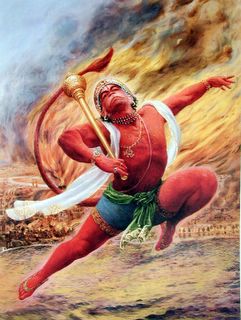
Spiritual Vibrations: My Hanuman Chalisa

My Hanuman Chalisa has been playing on my laptop since the End of April 2005. Continously, except
  • when the machine has to be restarted,
  • or theres been a powercut (I need to figue out how to launch iTunes automatically, to play the playlist Hanuman Chalisa),
  • or minus the weeks I was in England...
So, this morning, I look at my count - and it had reached 21,000 !!!

For those who are interested, one Hanuman Chalisa is 5 minutes and 35 seconds. I have 108 in my playlist. The playlist is set to start again when it finishes no. 108. The playlist is 10 hours long!

Pavansuta Hanumanji ki Jai !!!

Friday, October 21, 2005

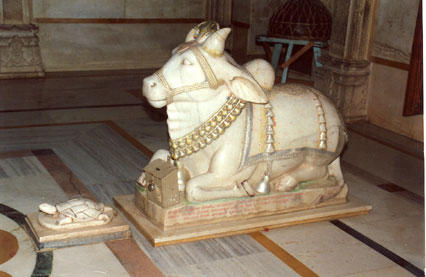
Question: Why is there is tortoise in front of Nandi?

I reader emailed me the following question:

We have the cow (Nandini) murti in the temple in front of the Shivaling. Then there is a tortoise in front of the cow. Why is that there?

Well reader, thank you for asking such a question, as it has not only enlightened me, but I am sure other readers of these pages will be delighted to learn about this symbolism too.

Let us first look at the symbolism of Nandi. Nandi is well known as the principal servant and vehicle of Lord Shiva. Nandi represents Bhakti and is always prostrate before the Lord. The tortoise represents vairagya. Just as a tortoise can entirely withdraw its limbs into its body, we should withdraw our senses away from worldly matters and into our souls. Together bhakti and vairagya are the pathway to God.

Nandi symbolizes the Aasan, which means to be firmly seated in ones place and posture. The aasan helps still the body. Nandi gazes up at the murti (face, idol) of Lord Shiva. We need to still our mind.

Once the mind is still, we have to withdraw our senses, which are forever craving for objects of pleasure in the external world and direct them inwards. The process of withdrawing senses from the temporal world is signified by the murti of the tortoise, placed ahead of the murti of Nandi. Just as a tortoise withdraws all its limbs within its shell, we should also withdraw our senses from objects of sensual pleasure.

The turtle could be the great Akupura on whose back rests the entire cosmos. Some believe that this turtle is Kurma, Vishnu's avatar who held aloft mount Mandara, which the Gods used as a churning staff when they churned the cosmic ocean. The turtle is also a symbol of Pratyahara or a yogic practice by which mystics dissociated themselves from all sensory stimulation and regressed into the world within, like the turtles could.

Thursday, October 20, 2005

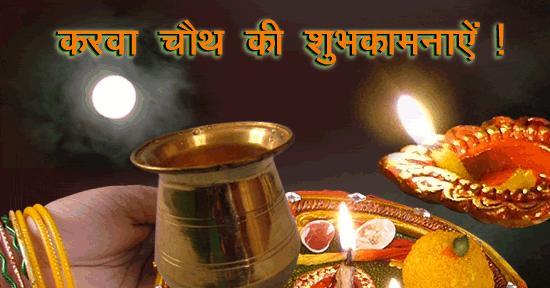
The Day of Karva Chauth...

Though Karva Chauth is a day marked with neither food nor water, this festival is quite popular among the newlyweds.

The Start Of The Day
On this day the women get up before sunrise. They worship Shiv-Parivaar (Shiva, Parvati, Ganesh and Kartikeya) and the moon. The blessings of the Gods are invoked for longevity and prosperity of their husbands and children. Mothers-in-law give their daughters-in-law sumptuous food called 'Sargi' to eat before sunrise, as the fast starts before sunrise and ends only after worshiping the moon at night. It is a tough fast, as the women do not take any food or water.

Dressing Up
In the evening, the women to cherish the joy of adorning bridal finery. Many times, the newly wed wear their wedding dress on this auspicious occasion, usually the ghagra-choli or Banarsi saris, embellished with the old-new shimmer of gold, diamonds and rubies. After dressing up, she receives gifts from the mother-in-law.

Evening Puja
Before evening, the married woman receives the baya or a basket full of goodies from her mother, which is meant for the mother-in-law. The basket contains sweets, mathadi, fruits and a sari. Before the sun sets, most of the women in a locality gather in one house and prepare a corner for the puja. This puja chowk is beautifully decorated and a small platform is prepared against a wall. On this, the image of Gauri Mata or Goddess Parvati is placed.

The Process Of Puja
The women sit around this image with their bayas. Each woman also places a karva or a pitcher full of water and seven pieces of pua in front of her. It is adorned with kharia, aipun and a little roli. A red thread is tied around the karva. At the beginning of the puja, women apply the roli teeka to Goddess Gauri and also to themselves. With the thumb and the third finger of the right hand, water is sprinkled on the image of the goddess. The same procedure is repeated with aipun and roli . Lastly, rice is showered on the image.

Narration of Vrata Katha
An elderly woman of the family narrates the legend of Karva Chauth. Even a widow can narrate this story. The women then pray for the long life and welfare of their husbands. While chanting the prayers, they pass their bayas from one to another. The wait for the moon rise begins after sunset, and as soon as the moon is sighted, prayers are offered to the moon. The fasting women first observe the moon through a sieve and then break their fast. The first sip of water and the first morsel of food is offered by the husband.

Finally, after a what seems like a long day, a sumptuous dinner follows.

Wednesday, October 19, 2005

Other Karva Chauth Stories

The Story Of Satyavan and Savitri
There is the story of the Satyavan and Savitri. When Lord Yama, came to procure Satyavan's soul, Savitri begged him to grant him life. When he refused, she stopped eating and drinking and Yamraj finally relented. He granted her, her husband's life. To this day, Karva Chauth is celebrated with great faith and belief.

The Legend Of Karva
According to another legend, a woman named Karva was deeply devoted to her husband. One day while bathing, he was caught by a crocodile. Karva came running and bound the crocodile with a cotton yarn. She then went to Yama, the Lord of the death, and requested him to send the offending crocodile to hell. When Yama refused, she threatened to curse him. Afraid of the power of a devoted wife, Yama readily accepted and sent the crocodile to Yamalok or hell, and blessed Karva's husband with long life.

Source: The Legend of Karva Chauth

Tuesday, October 18, 2005

Karva Chauth and Draupadi

The Legend During Mahabharata
The belief in this fast and its associated rituals goes back to the pre-Mahabharata times. Draupadi, too, is said to have observed this fast.

Once Arjun went to the Nilgiris for penance and the rest of the Pandavas faced many problems in his absence. Draupadi, out of desperation, remembered Lord Krishna and asked for help.

Lord Krishna reminded her that on an earlier occasion, when Goddess Parvati had sought Lord Shivas guidance under similar circumstances, she had been advised to observe the fast of Karva Chauth.

Draupadi followed the instructions and observed the fast with all its rituals. Consequently, the Pandavas were able to overcome their problems. On this day, fasting women listen to Karva Chauth legends with rapt attention.

Monday, October 17, 2005

The Story Behind Karva Chauth

The Story Of Queen Veeravati
A long long time ago, there lived a beautiful girl by the name of Veeravati. She was the only sister of her seven loving brothers, who was married to a king. On the occasion of the first Karva Chauth after her marriage, she went to her parents' house. After sunrise, she observed a strict fast. However, the queen couldn't stand the rigors of fasting and was desperatly waiting for the moon to rise. The seven brothers who loved her dearly, were very disturbed watching the distress of their sister and decided to end her fast by deceiving her. Then the brothers reflected a mirror through Pipal tree leaves. The sister, taken it as moon rise, broke the fast and took food. However, the moment the queen ate her dinner, she received the news that her husband, the king, was seriously ill.

The queen rushed to her husband's palace and on the way, she met Lord Shiva and his consort, Goddess Parvati. Parvati informed her that the king had died because the queen had broken her fast by watching a false moon. However, when the queen asked her for forgiveness, the goddess granted her the boon that the king would be revived. But to achieve this, she would have to undertake the Karva Chauth fast under strict rituals, then only her husband would come top life. Thus, by strictly following all the rituals of Karva chauth, queen Veeravati relivened her husband.

Source: The Story Behind Karva Chauth

Sunday, October 16, 2005

Karva Chauth - Thursday 20th October 2005

Karva Chauth falls on Thursday 20th October. Those who watch Hindi movies, will have seen this festival being celebrated - think of Kabhie Khushi Kabhi Gham...

The origin and significance of the fast is to ensure the well-being, prosperity and longevity of the husbands. Which means, that traditionally the fast is observed by married women only. However, traditions are changing, and many unmarried young women observe the fast for their future husbands or beloved, that wherever they may be, may they be happy and healthy.

The festival of Karva Chauth provides an opportunity for all married women to get close to their in-laws. Possessing a tremendous social and cultural significance, this festival is celebrated by keeping a strict fast, applying henna and exchange of gifts.

Celebrated mostly by North Indians, the festival is growing bigger due to its portrayal in the media, and commercial enterprise opportunities too. Along with traditional items such as mehandi, beauty products and fashionable clothes, the demand of special eateries are also gearing up. Nowadays, Karva Chauth is more of a fun festival than a serious and loving fast.

However, I strongly believe that any fast which is observed with shraddha, a pure mind and heart, will not only be beneficial for the person the male partner the fast is being held for, but the female too.

Saturday, October 08, 2005

The Different Forms of Durga

As the ten-armed Goddess, Goddess Durga presents a radiantly beautiful form that is bewitching to behold. That special form is somehow simultaneously wrathful and benign and transmits profound spiritual teachings in an exacting manner. The nine-day period from the new moon day to the ninth day of Ashvina is considered the most auspicious time of the Hindu Calendar and is hence the most celebrated time of the year as Durga Puja. The nine different forms of Devi are worshiped over the nine days. These are the most popular forms under which she is worshiped:

Durga Shailputri (Daughter of Mountain)
She is a daughter of Himalaya and first among nine Durgas. In previous birth she was the daughter of Daksha. Her name was Sati - Bhavani. i.e. the wife of Lord Shiva. Once Daksha had organized a big Yagna and did not invite Shiva. But Sati being obstinate, reached there. Thereupon Daksha insulted Shiva. Sati could not tolerate the insult of husband and burnt herself in the fire of Yagna. In other birth she became the daughter of Himalaya in the name of Parvati - Hemvati and got married with Shiva. As per Upnishad she had torn and the egotism of Indra, etc. Devtas. Being ashamed they bowed and prayed that, "In fact, thou are Shakti, we all - Brahma, Vishnu and Shiv are capable by getting Shakti from you."

Brahmacharini
The second Durga Shakti is Brahamcharini. Brahma that is who observes penance(tapa) and good conduct. Here "Brahma" means "Tapa". The idol of this Goddess is very gorgeous. There is rosary in her right hand and Kamandal in left hand. She is full with merriment. One story is famous about her. In previous birth she was Parvati Hemavati the daughter of Himvan. Once when she was busy in games with her friends. Naradaji came to her and predicted seeing her Palm-lines that, "You will get married with a naked-terrible 'Bhole baba' who was with you in the form of Sati, the daughter of Daksh in previous birth. But now you have to perform penance for him." There upon Parvati told her mother Menaka that she would marry none except Shambhu, otherwise she would remain unmarried. Saying this she went to observe penance. That is why her name is famous as tapacharini - Brahmacharini. From that time her name Uma became familiar.

Chandraghanta
The name of third Shakti is Chandraghanta. There is a half-circular moon in her forehead. She is charmful and bright. She is Golden color. She has three eyes and ten hands holding with ten types of swords - etc. weapons and arrows etc. She is seated on Lion and ready for going in war to fight. She is unprecedented image of bravery. The frightful sound of her bell terrifies all the villains, demons and danavas.

Kushmanda
Name of fourth Durga is Kushmanda. The Shakti creates egg, ie. Universe by mere laughing .She resides in solar systems. She shines brightly in all the ten directions like Sun. She has eight hands. Seven types of weapons are shining in her seven hands. Rosary is in her right hand. She seems brilliant riding on Lion. She likes the offerings of "Kumhde." Therefore her name "Kushmanda" has become famous.

Skanda Mata
Fifth name of Durga is "Skanda Mata". The daughter of Himalaya, after observing penance got married with Shiva. She had a son named "Skanda." Skanda is a leader of the army of Gods. Skanda Mata is a deity of fire. Skanda is seated in her lap. She has three eyes and four hands. She is white and seated on a lotus.

Katyayani
Sixth Durga is Katyayani. The son of "Kat" as "Katya". Rishi Katyayan born in this "Katya" lineage. Katyayan had observed penance with a desire to get paramba as his daughter. As a result she took birth as a daughter of Katyayan. Therefore her name is "Katyayani" . She has three eyes and eight hands. These are eight types of weapons missiles in her seven hands. Her vehicle is Lion.

Kalratri
Seventh Durga is Kalratri. She is black like night. Durga hairs are unlocked. She has put on necklaces shining like lightening. She has three eyes which are round like universe. Her eyes are bright. Thousands of flames of fire come out while respiring from nose. She rides on donkey. There is sharp sword in her right hand. Her lower hand is in blessing mood. The burning torch (mashal) is in her left hand and her lower left hand is in fearless style, by which she makes her devotees fearless. Being auspicious she is called "Shubhamkari."

Maha Gauri
The Eighth Durga is "Maha Gauri." She is as white as a conch, moon and Jasmine. She is of eight years old. Her clothes and ornaments are white and clean. She has three eyes. She rides on bull She has four hands. The above left hand is in "Fearless - Mudra" and lower left hand holds "Trishul." The above right hand has tambourine and lower right hand is in blessing style. She is calm and peaceful and exists in peaceful style. It is said that when the body of Gauri became dirty due to dust and earth while observing penance, Shiva makes it clean with the waters of Gangas. Then her body became bright like lightening. There fore, she is known as "Maha Gauri".

Siddhidatri
Ninth Durga us Siddhidatri. There are eight Siddhis , they are- Anima, Mahima, Garima, Laghima, Prapti, Prakamya, Iishitva & Vashitva. Maha Shakti gives all these Siddhies. It is said in "Devipuran" that the Supreme God Shiv got all these Siddhies by worshipping Maha Shakti. With her gratitude the half body of Shiv has became of Goddess and there fore his name "Ardhanarishvar" has became famous. The Goddess drives on Lion. She has four hands and looks pleased. This form of Durga is worshiped by all Gods, Rishis-Munis, Siddhas, Yogis, Sadhakas and devotees for attaining the best religious asset.

Tuesday, October 04, 2005

Navratri Garba-Raas in Gujarat

Did you know that there were other forms of Gujarati dance apart from the Raas and Garbo? The article below gives a brief description of each.

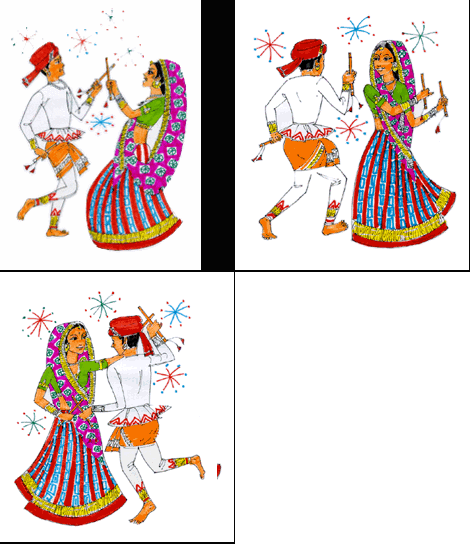
Gujarat, during the 9th century, was divided into four regions: Saurashtra, Kachchh, Aanara and Laat (south Gujarat). Raas, Garba, Hudo, Tippani are the dance forms of Saurashtra, while Dangi of Dharampur and Holi Nritya from Kawant are attributed to Laat. Garba, Garbi and Bhavai are the dances from Aanarta (north Gujarat), while Siddi Dhamal, Matukadi, Ged-do are original dances of Kachchh. Ideally, two circles formed by men and women move in clockwise and anti-clockwise directions with two sticks called dandiyas held in their hands. The song sung on the occasion is essentially an amorous one. Raas is a very energetic, colourful and playful dance providing opportunity for acting and exchanging messages through eye contact. It is no wonder that many romances bloom during Navaratri and hence the popularity of the dance among the younger generation.


Garba - Mainly performed by females in a circular formation, it is in reverences of goddess Ambaji. The basics of the dance are singing and clapping rhythmically while going round the goddess. Today, many modifications are prevalent to the basic pattern and even men are free to join in.

Garbi - Originally men use to perform this dance. It was on the way back from a battle that the victorious army would start dancing to couplets and amorous songs sung by the Charanswar, or the narrators who used to go to the front to raise the spirit during the battle by singing songs of valour. The dance was characteristic for its forceful movements which would fascinate viewers. Today, however, even females participate in the dance.

Hudo - It is the dance of the Bharwads, the shepherd community. The idea of the dance originated from sheep fights. The movements of two sheep ramming their heads is duplicated in the dance in which the dancers clap hands in a forceful and rhythmic manner.

Tippani - Many dance forms evolved from daily routine, and Tippani is one of them. It is the dance form of the labourers who are breaking stones or levelling the ground to break the monotony of the work. Females perform this dance with sticks in their hands which they strike on the ground to the beats of the drum.

Dangi - A dance form of the tribals from Dang, it is performed by both men and women. Dhol and pawri are the accompanying instruments of the dance which is highlighted by gymnastic skills. The strength and power of the dancers is depicted by the movement and the formation of pyramid spirals.

Dharampur - A dance which derives its name from the area. A tribal dance in which men paint their bodies and dance with weapons. Women join in dressed in colourful outfit.

Holi Nritya - A dance performed during Holi by the tribals of the eastern ghats of Gujarat. The dancers are dressed in peacock feathers on their head and waist and dance through the streets.

Siddi Dhamal - A unique dance style of Kachchh. The dancers dance with two thin sticks exhibiting their art and skill while dancing.

Ged-Do - Dance forms in this style of dance from Kachchh exhibit a complicated footwork by moving in a peculiar style akin to the movement of a horse in the game of chess. The dance also has a peculiar drum beat.

Matukadi - A female dance form from Gujarat, it is a very graceful one in which the dancers dance in a circular form in pairs.

Bhawai - This folk form enjoys the reputation of being the most entertaining style of dance from north Gujarat. It was on the verge of extinction after independence.

This post is especially for the Gujaratis out there!

Navratri - Nine Nights of Fun!

The 9 nights festival of Navratri begins on the first day of Ashwina of the bright fortnight - Tuesday 4th Ocotber 2005.
Seeds are sown, sprouting is watched, the planets are consecrated, and on the 8th and 9th days, Goddess Durga, Vijayashtami and Mahanavami are worshipped.

The Devi Mahatmya and other texts invoking the Goddess who vanquished demons are cited.

The day after Navratri i.e. the 10th day after Ashwina, is Dussera which celebrates the victory of lord Rama over Ravana. Ravana is burnt in effigy, often giant dummies of Ravana stuffed with fireworks are shot with arrows until they blow up before a large, applauding audience.

Thursday, September 29, 2005

The Bhagavad Geeta: c16.v21: The Divine And Demoniac Natures

tri-vidham narakasyedam
dvaram nasanam atmanah
kamah krodhas tatha lobhas
tasmad etat trayam tyajet


Synonyms
tri-vidham-three kinds of; narakasya-hellish; idam-this; dvaram-gate; nasanam-destructive; atmanah-of the self; kamah-lust; krodhah-anger; tatha-as well as; lobhah-greed; tasmat-therefore; etat-these; trayam-three; tyajet
-must give up.

Translation
There are three gates leading to this hell:
lust, anger and greed.
Every sane man should give these up,
for they lead to the degradation of the soul.

Puport
The beginning of demoniac life is described herein.
One tries to satisfy his lust, and when he cannot, anger and greed arise.
A sane man who does not want to glide down to the species of demoniac life
must try to give up these three enemies
which can kill the self to such an extent
that there will be no possibility of liberation
from this material entanglement.

Wednesday, September 28, 2005

Dharma Deck: Defense

Defense
One should defeat an angry man with meekness, an evil one with goodness, a miser with genorosity and a liar with truth.
- Mahabharata

Saturday, September 24, 2005

Dharma Deck: Humility

Humility
Listen to nature's teachings: be humbler than a blade of grass and more tolerant than a tree. Giving up worldly prestige, offer all respect to others and expect none in return.
- Sri Chaitanya

Tuesday, September 20, 2005

Dharma Deck: Virtue

Vitrue
Fortitude, forgiveness, self-control, honesty, purity of body and mind, sense-control, study of scriptures, meditation on the Supreme, truthfullness, freedom from anger - this is the tenfold parth of virtue.
- Manusmriti

Monday, September 19, 2005

Dharma Deck: Charity

I have a deck of cards from Mandala. There are 52 in total, and each one has a saying from the vedas, a saint or a swami. I shall try and share them with you here. I hope you have as much enjoyment as I did in reading these!

Charity
The sun evaporates water then returns it to the earch as rain -
similarly a wise person accepts life's gifts, then gives them to others when asked.
- Srimad Bhagavatam

Sunday, September 18, 2005

Enlightenment

I came across the following quote, and thought it quite apt - to direct to those individuals, who complain that the Hindu dharma is confusing:

If you feel that you are not enlightened, you can always try to be.
Harish Johari, Rasas Lecture Belgium 1997
Quoted from SanatanSociety.org

So, if you were hungry, would you just sit there and starve? Try and find out about things you are unsure about! Search for the light!